 Australian Computer Society
 Tom Worthington will talk about his experience in putting the Federal Government on-line. Tom will talk
about his work in on-line policy development and implementation in
the Department of Defence, on interdepartmental committees and for the ACS . He
will also discuss the steps Australian private and public organisations need to take to have a
stake in the global information industry. Tom will outline the up-to-minute
developments from Canberra.
Tom Worthington will talk about his experience in putting the Federal Government on-line. Tom will talk
about his work in on-line policy development and implementation in
the Department of Defence, on interdepartmental committees and for the ACS . He
will also discuss the steps Australian private and public organisations need to take to have a
stake in the global information industry. Tom will outline the up-to-minute
developments from Canberra.
Draft of 12 September 1996: The content of this talk will be developed here. Suggestions and comments welcome: tom.worthington@tomw.net.au
The vision essentially was that Australians would have easy, low cost access to on-line facilities for routine business, cultural and government activities. We wanted to make the Internet an ordinary tool for people to use. Much of that vision has already been achieved, through the work of people in Australian academia, government, industry and the community. However there is much to do.
 Exercise KANGAROO 95 took place in an area of over 4 million km
square, across the Top End of Australia from July to the end of August 1995 and involved over
17,000 Australian Defence Force
troops, and
visiting units
from the USA, Malaysia, Singapore, Papua New Guinea, the UK
and Indonesia.
Exercise KANGAROO 95 took place in an area of over 4 million km
square, across the Top End of Australia from July to the end of August 1995 and involved over
17,000 Australian Defence Force
troops, and
visiting units
from the USA, Malaysia, Singapore, Papua New Guinea, the UK
and Indonesia.
 Reports and photographs were transmitted from the exercise
area using stand-alone
portable satellite communications terminals, capable of full 64k
duplex high speed data.
Reports and photographs were transmitted from the exercise
area using stand-alone
portable satellite communications terminals, capable of full 64k
duplex high speed data.As manager of the Defence home page, I received the reports at Defence headquarters in Canberra and up-loaded, them to a publicly accessible Internet server at the Australian Defence Force Academy.
 During the exercise the Department of Administrative
Services announced K'95 trucking tenders on its
Government Electronic Marketplace Service (GEMS).
GEMS was linked to the K'95 home page, demonstrating the
synergy possible with the Internet.
During the exercise the Department of Administrative
Services announced K'95 trucking tenders on its
Government Electronic Marketplace Service (GEMS).
GEMS was linked to the K'95 home page, demonstrating the
synergy possible with the Internet.
"Commercial off the shelf" lap top computers and Internet software were used for transmitting the photos and reports. Photos were processed for efficient on-screen display, but also proved useful for printed reproduction.
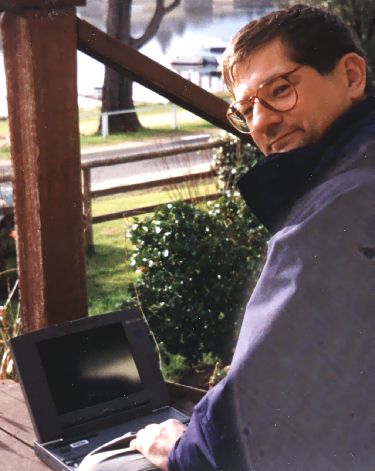 For the first week of the exercise I
was officially on holiday, but maintained the K95 home page
remotely using a pocket modem and lap top PC from
Mallacoota, Victoria.
For the first week of the exercise I
was officially on holiday, but maintained the K95 home page
remotely using a pocket modem and lap top PC from
Mallacoota, Victoria.
In the next few months the limitation will not be bandwidth or location, but people's ability to sift information. Already on-line executives can receive much more information in a day than they could absorb in a year. We are starting to see software for filtering information, so they get the high priority material, condensed in an easy to use form. This is especially a priority for Command Support Systems (CSS) systems. We will see the same techniques used to condense information for low bandwidth users.
Some examples of information condensing:
We will be launching the Defence Home Page MKIII in September and I hope to incorporate some of these techniques. It is easy to build a Web page with lots of flashy animated graphics which look good in a demonstration environment; it is difficult to build one which looks good and also gets useful information out to the public, but it is possible.



 Small and large organisations have the same leverage on-line: Unlike radio, TV and printed publishing
the start-up costs for on-line publishing are very low. Big organisations and small have the same access. Here
are two examples of Web pages about digital Airborne Surveillance systems from very different
sized organisations, prepared using the same technology.
Small and large organisations have the same leverage on-line: Unlike radio, TV and printed publishing
the start-up costs for on-line publishing are very low. Big organisations and small have the same access. Here
are two examples of Web pages about digital Airborne Surveillance systems from very different
sized organisations, prepared using the same technology.