Wednesday, November 12, 2008

Detect Influenza outbreaks with web searches

Graph of five years of flu estimates for US Mid-Atlantic region compared with CDC dataGoogle have created a service to "Explore flu trends across the U.S.". The system tracks the use of search terms which indicate that people have influenza and plots this on a graph over time and a map of the USA. According to "Google Uses Searches to Track Flu’s Spread" (By MIGUEL HELFT, The New York Times, November 11, 200), a paper on this will be published in Nature.The idea of using web searches to detect natural fonomina is not a new one, with previous proposals to use internet traffic to detect earthquakes. The technique might be used as part of an ICT system to deal with an Avian Influenza Pandemic.

Each week, millions of users around the world search for online health information. As you might expect, there are more flu-related searches during flu season, more allergy-related searches during allergy season, and more sunburn-related searches during the summer. You can explore all of these phenomena using Google Trends. But can search query trends provide an accurate, reliable model of real-world phenomena?

We have found a close relationship between how many people search for flu-related topics and how many people actually have flu symptoms. Of course, not every person who searches for "flu" is actually sick, but a pattern emerges when all the flu-related search queries from each state and region are added together. We compared our query counts with data from a surveillance system managed by the U.S. Centers for Disease Control and Prevention (CDC) and discovered that some search queries tend to be popular exactly when flu season is happening. By counting how often we see these search queries, we can estimate how much flu is circulating in various regions of the United States. ...

From: How does this work?, Google Flu Trends, Google, 2008

Labels: , , , ,

Friday, October 03, 2008

Fake blogs make Blog search risky

IT World reported a comparison of rival Blog search engines ("Is Google Blog Search a Techmeme killer? No way.", by Ian Lamont, October 2, 2008), so I did some ego surfing to see who said what about me. But the search resulted in so many scam blogs, it makes blog searching a risky business and not very useful.

A search for "Tom Worthington", taking out the references to my own site and other well known people of the same name (in the USA there is an attorney and a fish seller who frequently feature in news web sites), left only 122 references. Some of these were by me, others were just relays of posting from my own blog, but some were thoughtful, if not always positive, comments on my work. Some are from people I know, but most from people I don't. Even from people I know I was not aware of the postings.

One worrying aspect is that about one quarter of the postings seem to be pieces of random text copied from web pages to produce fake blogs, mostly on blogspot.com. These are then used to lure people to web sites packed with dubious advertising, re-directions and pop ups. One which seems popular with scams is Jim Byrne's summary of the web discrimination case "Bruce Maguire versus Sydney Organising Committee for the Olympic Games (SOCOG)", in which I get a mention. It is not clear why this would be used to promote sex web sites, but perhaps the document is very popular and so useful to attract web traffic.

The blog search engine designers need to improve their algorithms so reduce the risk of recommending fake blogs. The problem does not seem to occur with normal web searchers, so a solution should not be too difficult. The blog hosting sites, particularly blogspot.com, need to put in tests for such sites. This a serious problem which makes it so likely to end up at a dubious web site that it is not worth using a blog search at all, until it is fixed.

Labels: , ,

Tuesday, September 02, 2008

Google Chrome web browser detailed in a comic book

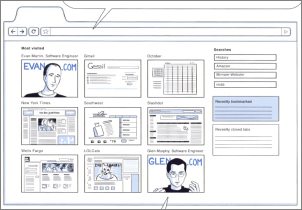
screenshot thumbnails from Google Chrome ComicGoogle was planning to release its own web browser, called "Google Chrome". But the details went out a few days early. The main feature is that it will be more reliable for running web based applications, with multiple processes. What is as interesting as the web browser itself, is that it is detailed in a comic book, put on the web by Philipp Lenssen. The comic format is similar to the storyboards which can be produced by scriptwriting software such as Celtx and perhaps is the coming trend in documenting technical systems.
At Google, we have a saying: “launch early and iterate.” While this approach is usually limited to our engineers, it apparently applies to our mailroom as well! As you may have read in the blogosphere, we hit "send" a bit early on a comic book introducing our new open source browser, Google Chrome. We will be launching the beta version of Google Chrome tomorrow in more than 100 countries. ...

From: A fresh take on the browser, The Official Google Blog, 9/01/2008 02:10:00 PM

Labels: , ,

Monday, August 25, 2008

Google AdSense for Feeds

Google now provide for advertisements in RSS and Atom feeds, including podcasts. Google's AdSense system allows someone who has a feed to have a text or image advertisement added to the top or bottom of each feed item (bottom is the default and seems a better idea to me). Google tracks who clicks on the ads, charges the advertiser and give the feed owner a commission. I have created one to try it out for my Net Traveller blog.

If this is too much for your readers, you can select ads to display every 2nd, 3rd or 4th item. By default the AdSense system will choose the colors and format of the ads (choosing the ad format can be bewildering for the beginner, so this is useful).

One issue may be with big ads in short postings. I have my feeds to only provide the first few lines of each posting. The idea is that this saves bandwidth: you then click on the link to get the full item, if you want it. But if each small item has a big ad on the bottom, it will get very annoying. Also I suspect there will be an arms race between designers of feed readers who will try to block the ads and Google making them appear.

The most confusing part of the process I found was that the feed ads only seem to work using Google's own Feedburner. That is you can't just put a code in your own feed code, as is done for ads on web pages. Instead you give AdSense the address of your feed and then it gets FeedBurner to create a version of it with the ads, supplied from the server. So your existing subscribers will not see the ads: you have to give them a new feedburner address.

Using FeedBurner might have advantages, if caches the feed. The feeds from my web server make up a lot of the download traffic and if I can get someone elee to do that it might be useful. It might be worth then providing the whole item via the feed, not just a summary.

FeedBurner provides facilities for checking on readership of feeds, but this is a whole new management system I have to learn about.

Labels: , , ,

Monday, May 12, 2008

iGoogle annoyances and Add to Google

Add to GoogleGoogle have taken another step to being everyone's default computer desktop with their customized iGoogle home page. With this you can customize the look of the home page with themes and add gadgets, such as news feeds. You cna then use this from any computer by logging in.

What I found annoying was I didn't ask for any of this, just one day recently iGoogle appeared when I went to do a Google search. The previous clean and simple Google search page was suddenly cluttered with news feeds, the time and date (why would I need a web widget to tell me the time and date?) and the like. It took me a couple of minutes to switch this all off (there is an option to revert to "classic Google", but a few of the iGoogle features are worthwile).

One featire I am trying out is "Add to Google Subscription Button". This lets you offer a button on your web site to allow readers to add your RSS feed to their iGoogle page. I didn't like the design of the button, so I just used the ALT text from it like this: Add to Google. The result is much the same as subscribing to the RSS feed, but instead of using the feed reader installed on your PC, the feed goes to the iGoogle home page. I can't imagine many people would want to keep my Blog feed on the home page, but it will be interesting to see how many do.

The add to Google also works with Gadgets (little web based services which will provide things like a news service, or a game). These could become a security and maintenance headache for system administrators.

Labels: , ,

Tuesday, May 06, 2008

Google's Infrastructure and Google Traffic

Google presented a Tech Talk at the ANU in Canberra today. Google comes to the university once a year to give some insights to how they do ICT and to recruit students.

This year's talk centered on Google's mapping function, which is developed in Australia. This can be used to easily develop mapping applications, such as for tracking vehicles.

Google's execution model uses racks of x86 computers, each of which has an IDE disk. A custom job scheduler allocates tasks to the CPUs, with the code written in C+. This is in many ways like an old fashioned job scheduling system, and in other ways like the systems used for managing scientific processing systems with very large numbers of CPUs. Google has centers distributed around the world, with the system routing jobs around problems, up to the loss of whole centers.

One interesting point is that HTTP is used for managing the jobs. Also there was a reference to "shards" of data. 64Mbyte chunks of files are allocated by the Google file system. Interestingly the same disk drives on the local clusters seem to be used both for the local temporary files and the long term Google file store.

One of the audience had used the open source version of the Google system for running a government application.

Google has jobs at its office in Sydney for software engineers, UNIX/Linux application administrators and product managers. There are also internships, graduate opportunities and a special scholarship for females. About one third of Google's staff come directly from university. Google has 60 engineers in Sydney and 140 other staff. Overseas students are welcome, provided they meet Australian immigration requirements. Google staff may also work at other offices around the world.

At question time I asked if there could be Australian involvement in the Sahana 2008 Google Summer of Code. This is to add mapping and other functions to the Sahana disaster management system (which I help with). The answer was that this tended to be a northern hemisphere event, but Google Australia is keen to foster Australian involvement.

Perhaps there would also be scope for Green ICT projects with the ACS Green ICT Group and Computers Off Australia (also Google has a new green building in Sydney). One possibility would be some online training materials to teach ICT people about power saving technology.

ps: Last year Google suggested ANU could replace its computer systems with Google's, giving each student a Google email address. There was also an emphasis on the Google free lunch and Google ethos. This did not go well with the audience and this year they did not make the same mistake. The presentation had much more of an Australian flavor to it.

Labels: , , ,

Sunday, April 27, 2008

Google Webmaster Tools

Google are now providing free Webmaster Tools. Like other free Google tools, clearly Google are getting something in return for providing you the service: the information you provide will help Google index the pages better, which is good for them (as well as you). To sign up for the servcie you need a Google account (usually a Gmail account). To use some you have to verify the web site you want to check is yours by uploading a code to the home page.

The servcie provides:
  1. Diagnostics
  2. Statistics
  3. Links
  4. Sitemaps
  5. Tools

Diagnostics

  1. Web crawl: problems Google had accessing pages. My site had no errors: HTTP errors , Not found, URLs not followed, URLs restricted by robots.txt, URLs timed out, Unreachable URLs.
  2. Content analysis: problems with site metadata (title and description information). Google found one of my web pages was missing a title. It also looks for duplicates, very long or titles and "non-informative" ones. The missing title turned out to be in a web page in the Moodle system.
  3. Mobile crawl: problems with pages designed for mobile phones. Google looks for CHTML and WML/XHTML . CHTML is a variant of HTML mostly used for Japanese mobile phones. Some of my pages have XHTML and CSS specifically designed for mobiles.

Statistics

Search queries

This shows which queries to Google returned pages from the site and which were most often selected by the person searching. This was an interesting list for mw web site as it differs from the results the statistics package my web server provides. The difference is essentially, that this is how others perceive the web site from the outside, not how I see it from the inside. As an example The 2020 summit does not figure highly in my web site stats:

Top search queries
# % Query Position
1 45% 2020 summit 23
2 25% 20 20 summit 11
3 4% 2020 summitt 9
4 4% australia 2020 summit 16
5 3% 2020 summit submissions 5
6 2% 2020 39
7 2% 2020 summit summary 9
8 2% australia 2020 28
9 2% "2020 summit" 17
10 1% 2020 summit video 6
11 1% 2020 summit australia 30
12 1% 2020 summit submission 4
13 1% alan smart 10
14 1% australian 2020 summit 11
15 1% what is the 2020 summit 15
16 1% smart 33
17 1% cookies enabled on your browser 4
18 1% forum 2020 4
19 1% 2020 summit governance 7
20 1% 20 20 summitt 10

Top clicked queries


# % Query Position
1 27% konkan railway 5
2 18% 2020 summit official opening speakers 2
3 18% 2020 summit submissions 5
4 18% australia 2020 summit submissions 5
5 18% indian ferry 7

Crawl stats

The crawl stats are a little hard on the ego, as it shows what proportion of the pages have a high, medium or low PageRank. Most of mine rated low. My highest rating was one on the accessibility of Olympic web sites.

Subscriber stats

This shows hom many have subscribed to RSS feeds using Google services, such as such as Google Reader. There were none for my site, although I have an RSS feed on it.

What Googlebot sees

This shows words and phrases in the anchor text of links to the site. This is not information from the site itself, but what other people used to describe it, when linking to it. So this is what the system which collects links to the site (the "Googlebot "), sees.

This information is quite confronting as it does not necessarily match the idealized picture of how you see your carefully crafted web site being viewed. Also in some cases you say "who was silly enough to say that?" and find the phrase is from something you wrote. Here are the top few phrases and words from my site (Google provide a longer list):

Phrases in external links:


1. open 2020 summit moodle
2. all the notes
3. help cookies must be enabled in your browser
4. moodle for local summit details and links
5. create new account
6. http tomw net au moodle course view php
7. new account
8. summit on open source
9. writing for the web
10. aide votre navigateur doit supporter les cookies

Keywords In your site's content

1. australian
2. australia
3. government
4. tom
5. computer
6. worthington
7. system
8. technology
9. post
10. canberra

Keywords in external links to your site

1. tomw
2. stores
3. net
4. other
5. line
6. online
7. html
8. ltd
9. pty
10. communications

Pages with external links


This shows which pages external sites are pointing to. This list did not make a lot of sense at first. As an example, there was an entry for http://tomw.net.au/moodle/course/view.php?id=9 with 74 links. On closer inspection, this turned out to be the page for the Open 2020 Summit and numerous people had put in links to it. But I think I still don't quite understand what this report is trying to tell me.

Sitelinks

Sitelinks are a small table of contents which Google generates itself and places in its search results. My site doesn't have one of these, which might suggest the site is not clearly enough organized for Google's algorithm to work it out. Sightlinks have been controversial as they might supplant the web site's own navigation.

Pages with internal links

This provides pages pointed to from other pages on the site. This was not a lot more use than the tools usually provided with web development tools.

Sitemaps

This reposts any sitemaps associated with the web site. These are XML files which provide Google bot (and other web crawlers) with a list of the pages on the web site and make it easier for new pages to be indexed. This can reduce the traffic on the web site from web crawlers and allow them to index the site more frequently. Google provide a list of tools which can be sued to generate the sitemap. Ideally this should be built into the web server, so each time a page is added, or changed, the site map is updated. But there are some external web based tools, such as Xml-sitemaps.com to try.

Labels: ,

Wednesday, September 26, 2007

Google Ads on Mobile Phones

After years of trying, and failing, to interest people in the problem of providing accessible web sites for the disabled, I gave up. But I think they will listen to how to put Google ads on mobile phones (which uses the same accessibility techniques). All welcome at this free seminar in Canberra:
Seminar Announcement
Department of Computer Science, FEIT
The Australian National University

Date: Monday, 15 October 2007
Time: 4:00 pm to 5:00 pm
Venue: Room N101, CSIT Building [108]

Speaker: Tom Worthington

Title: Google Ads on Mobile Phones: accessibility, standards and implementation

Abstract:

Google's AdWords/AdSense system allows businesses to advertise on the web. This service was recently expanded to provide advertisements on mobile phones using XHTM/WAP 2.0, WML/WAP 1.0 and CHTML/iMode, implemented with PHP, CGI Perl or ASP. This is a brief overview of how the Google system is implemented and a demonstration. The differences between the system for desktop and hand held devices is discussed, as is Google's adherence (or lack of) to web standards. The accessibility of the ads, particularly for disabled will also be looked at.

Biography:
Tom Worthington a Visiting Fellow in the Department of Computer Science, Faculty of Engineering and Information Technology at the Australian National University, where he teaches the design of web sites, e-commerce and professional ethics. Tom has been an expert witness in several court cases involving international patent, computer, web and Internet issues, as well as advising governments and companies on ICT problems. In 1999 he was elected a Fellow of the Australian Computer Society for his contribution to the development of public Internet policy.

Notes: http://www.tomw.net.au/technology/it/google_mobile_ads.php

DCS Seminars: http://cs.anu.edu.au/seminars/

Labels: , , , , ,

Tuesday, September 11, 2007

St George Bank Annoying Queuing System

Amazon.com sent me a check for royalties on online sales. These are difficult to deposit and made more difficult by a very annoying queuing system introduced by St. George bank.

Unlike Google, who send checks in Australian dollars (and even do direct deposit to Australian banks), Amazon.com send paper cheques in US dollars. At least I think they are in US dollars, as the cheques do not identify the currency or the country they are from. The first time I tried to deposit one of these the teller looked at me suspiciously.

This time I did not manage to get to the teller at all. St. George Bank have introduced a "take a number" queuing system. I pressed "international transactions" and was issued number "D810". A screen showed that A240 was being served, as were some B and C numbers, but no Ds. So I had no idea when, or if, I would ever have a turn. After a while of standing around and seeing if there was any way to find out, I gave up and put the cheque in a deposit envelope in a slot.

The bank called the next day to say that I must come to the counter to deposit overseas cheques. However, by then I was interstate. The following week I turned up at the branch used the name of a teller to bypass the queuing system. This seems a bizarrely inefficient way to run a bank and is not good for the customer.

In the longer term I will see if I can find another bank which does not have this very customer unfriendly system, which seems to be designed to drive people away from St. George bank. Or perhaps Amazon.com will realize that not everyone in the world works in US currency and will have a direct deposit system in US dollars by the time of my next payment.

Labels: , , ,

Tuesday, August 14, 2007

Google Adsense Referrals 2.0

Google added an expanded "Referrals 2.0" feature to its web advertising service in 2007. In theory this should provide more revenue from the Google Adsense advertisements on my web site, but so far the results have been disappointing.

Google previously paid a referral fee when customers were referred to Google services, such as downloading the Google toolbar. This has now been extended to referrals to other companies. So if, for example, a customer clicks on a Google ad and buys an airline ticket, the airline pays a referral fee to Google. In theory this is better for advertiser than the regular Google AdWords service, where advertisers pays when the the customer clicks on an ad, even if they never actually buy anything.

So far the results from Referrals 2.0 have been disappointing. Over the last few weeks I have tried some Referrals ads on some web pages. These have resulted in 31,640 third party ad impressions (number of times the ads appeared), 44 clicks (people selecting to look for further details from the ad), but no signups (people registering or buying the goods). As a result there was no revenue from this. The Referrals displaced other regular Google ads, resulting in a drop in Google revenue overall.

It may that it is too early to judge the success of Referrals. One problem seems to be that there are few quality advertisers using the service. Also the matching of advertisers to web pages does not seem as finely tuned as Google's regular ads. There are many ads which do not seem to match the topics of the web sites they appear on.

Labels: , ,

Tuesday, July 31, 2007

Big Brother Google?

Recommended:
DCS SEMINAR SERIES

Big Brother Google?
Roger Clarke (DCS, ANU & Xamax Pty. Ltd.)

DATE: 2007-08-27
TIME: 16:00:00 - 17:00:00
LOCATION: CSIT Seminar Room, N101, ANU

ABSTRACT:
Google is increasingly being perceived as the company that will follow IBM (1965-85) and Microsoft (1985-2005) in dominating the IT industry. This presentation will outline the many business lines that Google is endeavouring to build, and then focus on what has become the major part of its business - knowing a lot about people.

http://www.anu.edu.au/people/Roger.Clarke/EC/ANUSems.html#Sem19

BIO:
From 1984-95, Roger Clarke was Reader in Information Systems in ANU's then Department of Commerce. Since then he has been back in full-time consultancy through his company, Xamax Consultancy Pty Ltd. He focuses on strategic and policy aspects of eBusiness, information infrastructure and dataveillance and privacy.

He has retained his connections with academe as a Visiting Fellow in the ANU Department of Computer Science (1995-2005) and as an Adjunct Professor from April 2005. He is also a Visiting Professor in eCommerce at the University of Hong Kong (2002-), and a Visiting Professor in Cyberspace Law & Policy at UNSW (2003-). He has also undertaken Gastprofessur at the Universities of Bern (Switzerland) and Linz (Austria), and been a Gastdozent at the European Business School and the University of Koblenz (both in Germany).

http://www.anu.edu.au/people/Roger.Clarke/EC/ANUSems.html#Aff
---

Labels: , ,

Wednesday, April 04, 2007

Google jobs and scholarships in Australia

Last week, Will Blott and Alan Noble from Google's Sydney office and Neetu Sabharwal from their ANU in Canberra.

Google are expanding their Sydney engineering center. So they need students to work as "interns" and also graduates. On the visit the Google staff emphasized that they want people who can write useful computer programs. This is different to some centers where one group of people theorize and then hand it to someone else to build a working system.

The popular Google Maps started in Sydney (at a company Google acquired). They can't say what is currently being worked on, but there is a list of jobs on the Google web site.


For students, Google offer:
One thing Google don't mention in their advertising, but which I discussed with them on their visit, is that they have labs in other countries in the Asian region. Students studying in Australian universities may well find it easier to get into Google in Australia, than in their home country. Once in, they can look to work at another Google center.

Labels: ,

Friday, March 30, 2007

Google Came to Canberra

On Thursday, Will Blott and Alan Noble from Google's Sydney office and Neetu Sabharwal from their ANU in Canberra:
"Google Australia is looking to forge relationships with key universities as they now have a dedicated 'on campus' focus in Australia. Google is keen to explore opportunities to partner that will add value to students' experience and help develop computer science engineers for Australia. ".
The overall message from the visit is that Google is looking for staff who can write useful computer programs. They are happy to provide support to researchers, to offer students the opportunity to work with Google people, but in the end they want people who can write useful computer programs, not just research papers. This was a refreshingly down to earth view.

One aspect I found interesting was Google's global nature. The company has a US West Coast base. This results in some slightly annoying cultural aspects of their promotional material making them a bit like a cross between the McDonalds hamburger chain and The Wiggles. But Google is developing labs around the world which are growing rapidly. While the staff are physically located in one lab, they work with those in others.

National research offices for global corporations can have their problems. When I visited Microsoft Research Labs in Cambridge (UK), there seemed to be a fear that they would be out researched by low cost PHDs at Microsoft Beijing. Google use their company culture to attempt to overcome this.

One interesting aspect of having a Google center in Australia is that students from the Asian region at Australian universities might have a better access to Google scholarships and jobs than they would at home. There is a much smaller pool of students in Australia to compete for attention, than at an Indian or Chinese university. Once in the Google door, they then have access to the Google center in the home country.

Google Work With the ANU

Before Will and Alan gave a seminar, there was a discussion of possible areas for cooperation. Three areas I thought worth looking at were:

* Digital Mapping for the Public Good: Mobile phones for bushfire mapping, and applications for a GPS open source smart phone.

Sentinel Interactive Fire Tracking Map DemonstrationBushfire mapping

One student evaluated what was needed for an emergency management web site.

One application is adaption of the Sentinel Fire Mapping System for mobile devices. An experimental alternative web interface is available.

* Broadband Applications for Non-Broadband Users: New web applications are tending to require more and continuous network access. This makes it more difficult for those still on slow dial up connections and for wireless users with slow intermittent connections. These could be people in developing nations, such as India and China, but also in regional parts of places like Australia. These might not sound like high value customers for a company to target, but many of the same techniques used to provide Internet applications to rich people with smart phones can also be used for slow dialup users.

Sahana home page on a mobile phoneAn example is to modify the Sahana open source disaster management system for a phone.

* Cultural Links: As I found when teaching web design to museum workers in Samoa, there is great interest and value in providing web access to cultural material. But this tends to result in relatively dull, academic web sites, separate from the lively commercial stuff. Creating lively web sites is hard work. It should be possible to enhance the culturally worthy stuff, using some automated techniques like those applied commercially.
Ten Canoes Study Guides
Two students undertook projects to provide a better web interface to Australian museum materials, including those which inspired the movie Ten Canoes.

One student now working out how to use this to provide more relevant links from the ACS Digital Library to services such as Google.

Google Apps

There was a little of a sales pitch in the visit, with Google saying how good their Google Apps Education Edition. I am not sure how many universities, or companies, would be convinced of this. While organizations may be willing to use free third party systems to allow people to interact remotely, they are reluctant to have these systems as part of their "mission critical" applications. They are even more reluctant to have their data stored on someone else's system at an indeterminate location in some other country under that country's laws.

A lot of this reluctance to use external providers is irrational. Shared and remote systems used to be an everyday part of computing. Google's system is likely to be more reliable than the average corporate system and there are benefits in having your data stored away from head office. In a recent case a hail storm closed several buildings in Canberra for days. The ANU campus was closed, but the computer systems kept working and people were able to work remotely. With something like Google Apps an organization would be able to keep working remotely (perhaps even via smart phones).

However, I have to admit that while I use Google's Blogger service to prepare my blog, I still get it to put the files on my own web server located in Australia. I like the comfort of my data on a system I am paying for in a location under the same laws. Google will be hampered in promoting Google Apps in Australia, as their data centers are located in other countries, and so mostly not subject to Australian law.

Google would have difficulty locating a data center in Australia, as there are limited international telecommunications links to Asia and the USA. Perhaps the ALP could dip into the Future Fund some more to pay for extra fibre optic links to the USA and Asia. Given the amount of traffic coming from Google, this may have a significant impact on Australian telecommunications.

Labels: , , , ,

Thursday, March 22, 2007

Google Comes to Canberra

Next Thursday Will Blott and Alan Noble from Google's Sydney office are visiting the ANU in Canberra.

The first part of the visit sounds like a sales pitch: "Google Australia is looking to forge relationships with key universities as they now have a dedicated 'on campus' focus in Australia. Google is keen to explore opportunities to partner that will add value to students' experience and help develop computer science engineers for Australia. ".

The second part is a technical presentation on the development being done for Google in Sydney, including Google Maps.

While I have been aware of some involvement of search engine developers locally, it will be interesting to put faces to names. The Standford University lab where Google originated uses my web site to test new search technology. AT one stage I had to tell them to slow down the crawling of my site. Some people from ANU have gone to work at Google and Microsoft on search technology.

Relevant projects at ANU include ones on semantic web for cultural publishing, mobile phones for bushfire mapping, and applications for a GPS open source smart phone.

Ten Canoes Study GuidesSemantic Web for Cultural Publishing

Two students undertook projects to provide a better web interface to Australian museum materials, including those which inspired the movie Ten Canoes.

One student now working out how to use this to provide more relevant links from the ACS Digital Library to services such as Google.

Sentinel Interactive Fire Tracking Map DemonstrationBushfire mapping

One student evaluated what was needed for an emergency management web site.

One application is adaption of the Sentinel Fire Mapping System for mobile devices. An experimental alternative web interface is available.

Sahana home page on a mobile phoneAnother application is to modify the Sahana open source disaster management system for a phone.

Labels: , , , ,

Friday, February 16, 2007

My First Cheque from Amazon

Amazon.com ChequeThis photo is of my first cheque from Amazon.Com for selling products on my web site. In return for linking to Amazon from my web site, I get a commission on sales. This is not going to make me a fortune, but I wanted to see how it works as an example of e-commerce.

I gave the ANU e-commerce students a lecture on Web Services using the Amazon system. The students tend to doze off when I am telling them how to use the web, metadata and all that technical stuff to do business on-line. What gets their attention is when I talk about something selling books and use the magic words: "this is not just theory, I use this to make MONEY". :-)

Amazon provide facilities for showing products on-line, similar to Google's AdSense. But Amazon's systems seems less able to select products the customer would be interested in. I set the ANU students an assignment question to work out how to interface to Amazon's system to create a better service.

The Amazon commission did not earn enough for them to send me a payment for about a year (they don't send one until it gets to $US100). But last October it started earning $US100 a day. This dropped back to a few dollars a day shortly afterwards and I never worked out what caused the spike.

Banking the cheque from Amazon turned out to be difficult. Unlike Google, who send cheques in Australian dollars (and now have an electronic deposit option), drawn on an Australian bank, Amazon's was in US dollars. So I had to take it to a special counter at the bank. Amazon do not write on the cheque that it is in US dollars, nor that they are in the USA, which caused some confusion. The teller had never heard of "Amazon Services LCC" which made them suspicious. The address at a PO Box in "Incline Village, NV" made them more suspicious. From Google Maps, this seems to be a small settlement next to a golf course.

Labels: , , ,

Monday, February 05, 2007

Corporate social networking with web 2.0?

The IT business media seem to be taking Web 2 seriously, so perhaps it is time to look at it. But there seem to be several concepts mixed up together (or perhaps "mashed up"?). Sorting this out may solve some problems in corporate document management and academic publishing.

One is the use of AJAX and similar technology to provide a more interactive interface via the web. Another is traditional office applications provided via the AJAX interface (such as word processors and spreadsheets). The third is on-line meeting places, such as MySpace.

There is also YouTube, a video sharing web site, which usually gets mentioned in the same articles but does not seem to have anything to do with social networking or corporate applications, but just gets included because it is popular.

Capitalizing on Interactivity, Mobility and Personalization by Donna Bogatin, January 22nd, 2007:
Categories: Business Models, Web 2.0, Culture, Google, Blogs, User-Generated Content, MySpace, Social Web, Amateur Content, Self-Promotion, Google Software Applications, Social Networking, Social Media

Is MySpace coming to the enterprise? According to Business Week it is.

On what does Steve Hamm base his assertion? IBM's announcement today of “Lotus Connections.”

IBM describes its offering as “the industry's first platform for business-grade social computing”:

Lotus Connections facilitates the gathering and exchange of information through professional networks, provides a dashboard-like view of current projects and connects users to like-minded communities. In addition, Lotus Connections removes the need for multiple social software applications, providing businesses with a single destination for building professional communities. ...
Corporate social networking is name of game with Lotus Connections, By Stan Beer, 24 January 2007 :
While Microsoft has been trying to win Web 2.0 corporate hearts and minds with Sharepoint Server, IBM threatens to steal the show with a new corporate tested offering called Lotus Connections. Web 2.0 in the consumer space is all about social networking as exemplified by sites such as MySpace, YouTube and FaceBook. Users of these sites with common interests can network, share ideas and provide each other with information that builds upon their mutual knowledge base.
The idea of using more interactive web applications makes sense in the corporate environment, provided you have the bandwidth and processing power to do it and accept its limitations. In some ways this is a step back to centralized mainframe computing, with the web application running on the server. If the central application stops, no one can do any work. This would be a good way to go if you have a new application to introduce across a wide network.

The extreme case seems to be to run your corporate service on someone else's web server. Google have a service called "Google Apps for Your Domain" which provides online tools for email, instant messaging and shared calendar. The idea is that the same tools used for Google's Gmail and others are available for use by companies, educational institutions and other organisations. They use the Google system in place of their own in-house software.

Google are not charging for these services, but presumably are doing it to make people more familiar with Google's services which have advertising on them:

Google Apps for Your Domain lets you offer private-labeled email, instant messaging and calendar accounts to all of your users, so they can share ideas and work more effectively. These services are all unified by the start page, a unique, dynamic page where your users can preview their inboxes and calendars, browse content and links that you choose, search the web, and further customize the page to their liking. You can also design and publish web pages for your domain.
I remain a bit skeptical of online meeting places as a business tool. Any form of collaboration requires skills from the participants. Not everyone has these skills and corporations will need to invest in training and staff to make them work. As well as cooperation, workplace involve competition. Perhaps rather than a social network, an information market would be a better model for the on-line workplace. Also much social networking takes place outside the organisation.

Are companies prepared to formalize and document online the process by which their staff trade information with other organisations? In many cases these contacts take place verbally and informally, while tacitly endorsed by superiors. If the contacts took place via a computer system, all transactions would be recorded and could be used in evidence in court. Much of these contacts would be considered unethical or illegal, limiting the scope for using a formal system.

What has this to do with corporate document management or academic publishing? Organisations, particularly governments, are having difficulty with staff filing electronic documents properly. Academia are having difficulty over the role of academic publishing. In both these cases the problem is that the records manager or librarian sees the document or publication as an end in itself.

But the office worker or academic author sees them just as part of a process; a byproduct of doing some work or some research. By incorporating the social network process in the system used to produce the document, keeping good records or publications will be a natural by product of the work. This is more than just an automated work flow which prompts you for some keywords before you can save a document.

Labels: , , , , , , , , , , , , ,